Overview
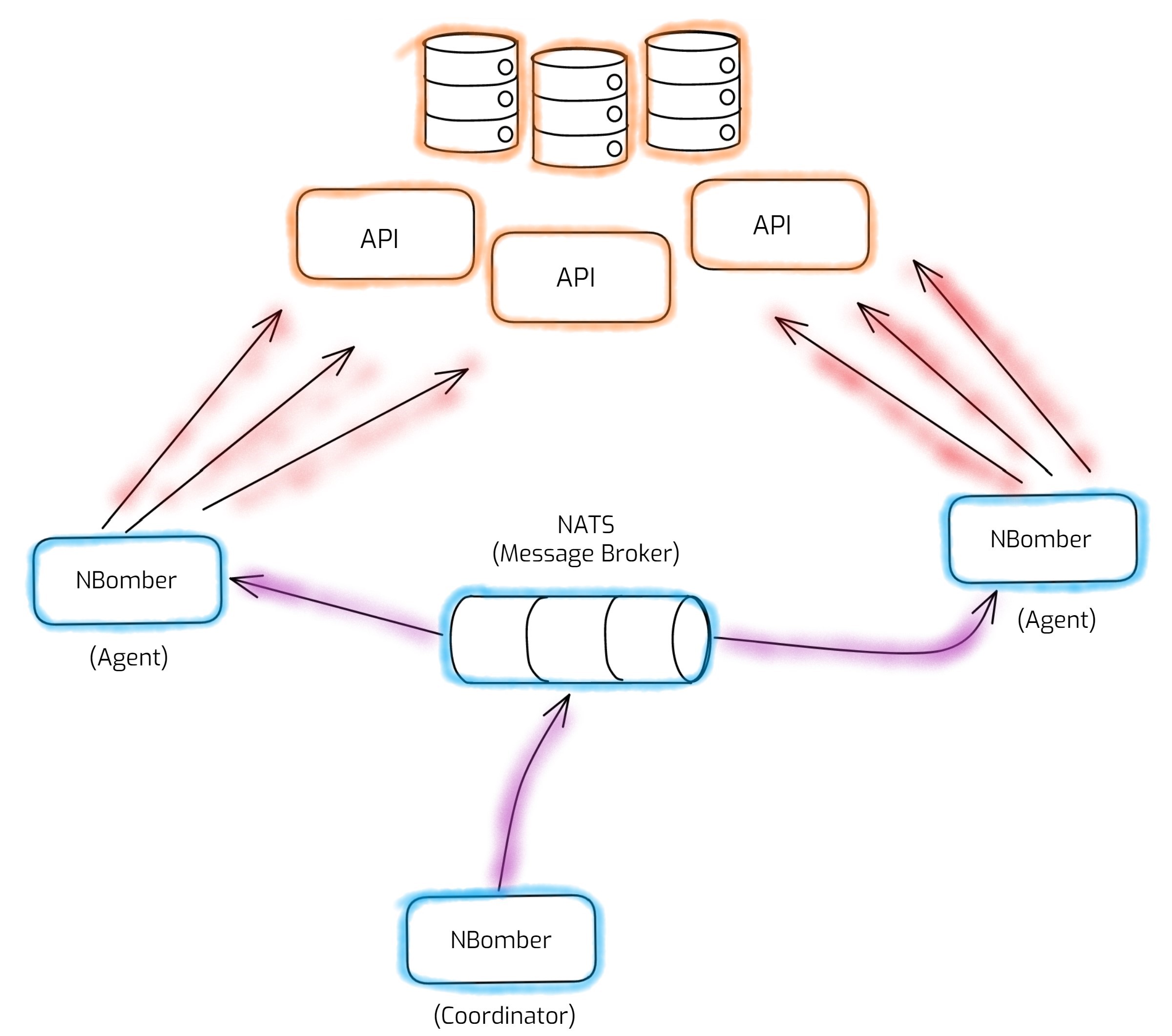
NBomber Cluster allows you to run load tests distributed across multiple nodes, with control over where each scenario runs.
You can try and run NBomber Cluster without a license key. For details, see Local Dev Cluster.
When do you need a cluster?
-
A single NBomber node can no longer generate the required load, and you need to distribute scenarios across multiple nodes.
-
You need flexible scenario placement across available nodes. You can specify placement for each scenario in the cluster. For example, run
CreateUserScenarioon one group of nodes,ReadUserScenarioon a second group, andSaveUserScenarioon a third. -
You need to run tests from different geographical regions to measure latency from multiple locations.
NBomber Cluster uses the NATS message broker for communication between nodes. Please refer to this installation guide to install NATS since NBomber Cluster depends on it.
Setting up a cluster manually means installing a NATS broker and starting multiple NBomber processes yourself. NBomber Studio automates all of this in Kubernetes — it provisions NATS, deploys your test across as many Agent Pods as you configure, and tears down every resource it created once the test finishes. It's a full load testing platform built for NBomber.
What does NBomber Cluster provide?
- Scalability of load — distributes scenarios across multiple nodes to generate more load than a single node can produce.
- Runs multiple scenarios on multiple nodes with flexible topology (scenario placement strategy).
- Continuously collects metrics from all Agents and calculates overall statistics at runtime. Threshold checks run on the Coordinator node.
- Collects hardware metrics (CPU, RAM, IO, etc.) from all Agents. These metrics can be used in threshold checks.
- Provides auto partition assignment for the same scenario across the cluster. This is useful when you need to split data responsibility between Agent instances. Each Agent running the same scenario automatically receives a partition number (key range) that can be used to load, prepare, and work with its assigned data.
- Produces all report types (TXT, CSV, MD, HTML) with summary across all nodes in the cluster.
- Produces real-time reporting for the whole cluster.
Terminology
Cluster mode introduces two distinct roles: Coordinator (aka Leader) and Agent (aka Worker). To form a cluster, you need 1 Coordinator + N Agent(s).
Each NBomber instance (process) runs as either a Coordinator or an Agent. There can be only one Coordinator per cluster, and the cluster cannot start without it. You can run an unlimited number of independent clusters in parallel, each containing 1 Coordinator + N Agent(s). Cluster members discover each other by ClusterId (think of it as a virtual cluster id).
Coordinator
The Coordinator orchestrates the entire test. It can also execute scenarios, just like an Agent — you control which scenarios run where. This is useful for running a scenario as a singleton in the cluster (for example, periodically writing a message to Kafka). Alternatively, configure all scenarios to run only on Agents, leaving the Coordinator free to act purely as an orchestrator: fetching metrics from Agents and evaluating thresholds. In a JSON config, the Coordinator section is optional — by default the Coordinator runs no scenarios and acts purely as an orchestrator (the role still exists; only the config section is optional). See Running scenarios on the Coordinator if you want it to run scenarios too.
Keeping the Coordinator free of heavy scenarios is recommended — an idle Coordinator won't distort your load test results.
Agent
The Agent executes load test scenarios and responds to commands from the Coordinator.
Message Broker
The Message Broker is the communication layer of the cluster. NBomber uses NATS for this role. All traffic between the Coordinator and Agents flows through it: the Coordinator sends commands to Agents, and Agents send metrics back for aggregation.
For isolation, we recommend running a dedicated single-node NATS per cluster session. In this case, you can just hardcode ClusterId=default since your cluster is the only one using that NATS instance.
A single NATS instance can also serve multiple NBomber clusters running in parallel. In this case, each concurrent cluster session must use its own unique ClusterId so members don't collide. For example, if two teams each run a clustered load test against the same shared NATS instance at the same time, one team could use ClusterId=team_1 and the other ClusterId=team_2.