Data Partition
In more advanced cluster scenarios, you may need to split your data across Agents so that each one works on a different slice (key range) — and no two Agents touch the same records. NBomber handles this automatically with Scenario Auto Partitioning. During scenario initialization, each Agent receives a unique partition number (1, 2, 3, …), which you use to calculate the data range it should handle. For example, with 3 Agents you might assign user IDs 0–100 to partition 1, 100–200 to partition 2, and 200–300 to partition 3.
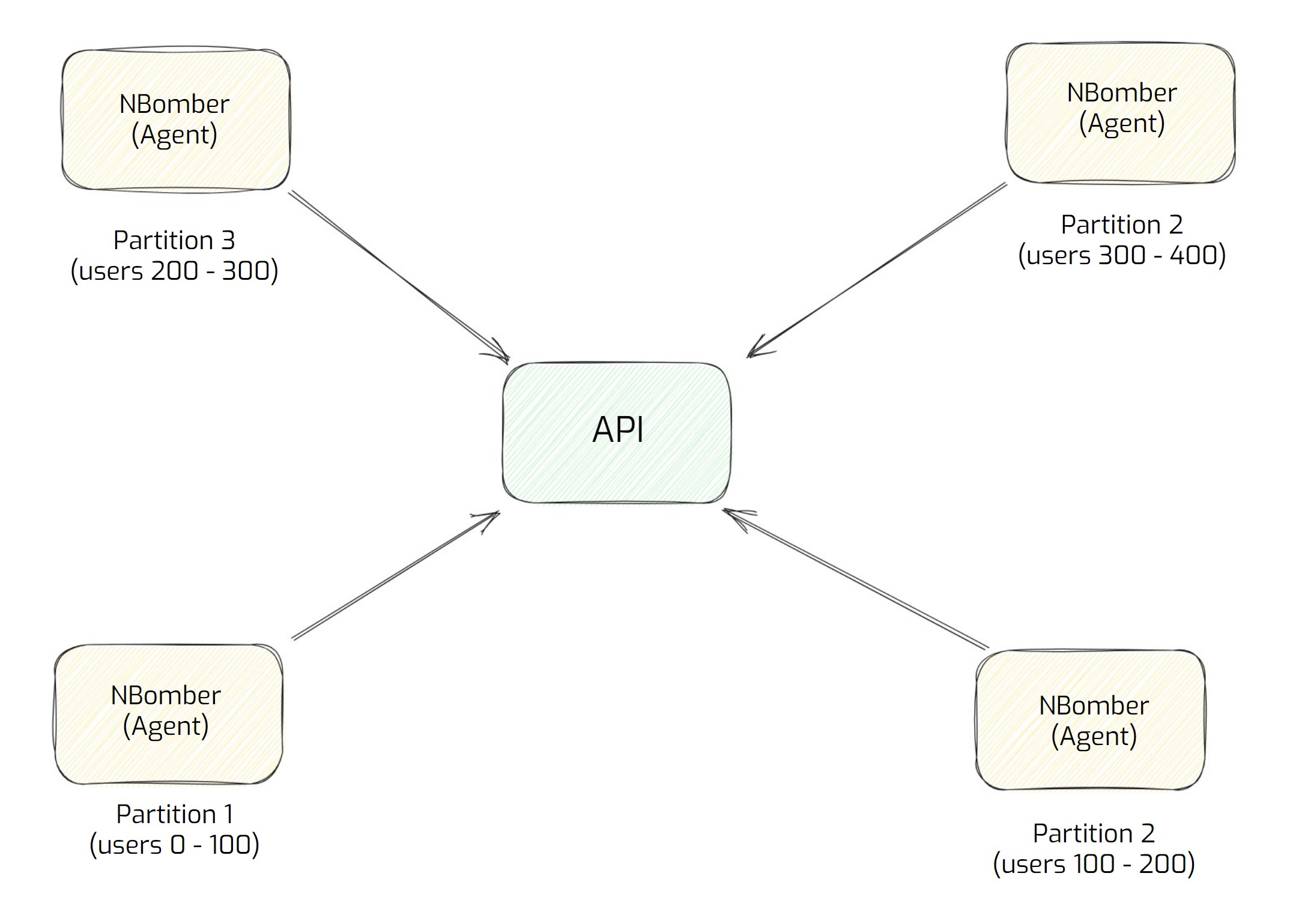
Scenario Auto Partitioning
When you run a Scenario in the cluster, NBomber will:
- Find all Agents running that Scenario.
- Assign a unique partition number to each of them automatically.
You can read the ScenarioPartition during the Scenario Init phase and use it to derive which key ranges to load.
Scenario
    .Create("my-scenario", async context => { ... })
    .WithInit(context =>
    {
        // Number: this Agent's partition (e.g. 1, 2, 3, …)
        var partitionNumber = context.ScenarioPartition.Number;

        // Count: total number of partitions across the cluster.
        var partitionCount = context.ScenarioPartition.Count;
    })